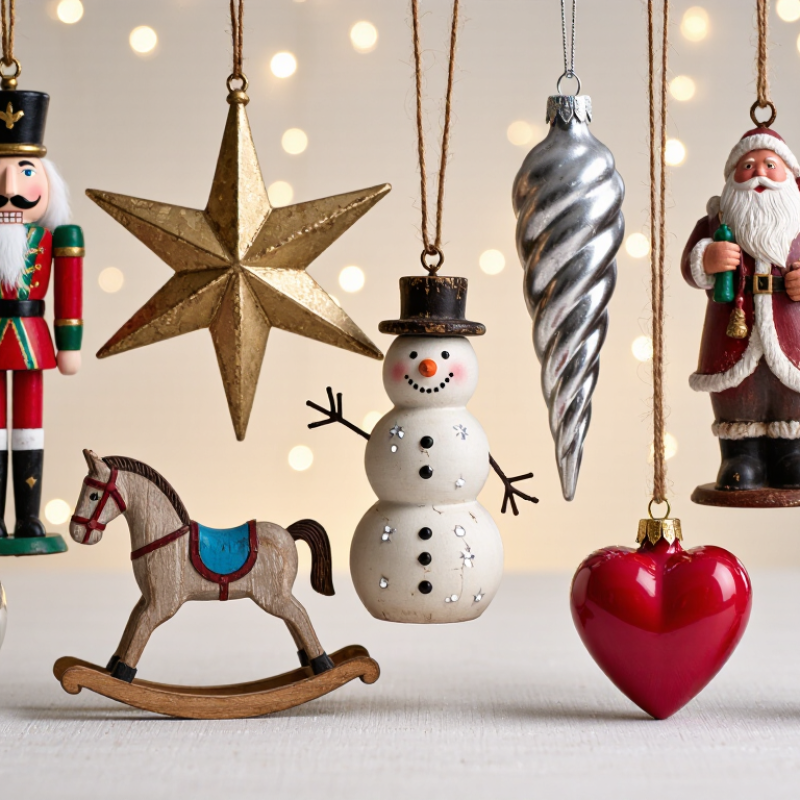
For global collectors, Antique Christmas Ornaments offer more than seasonal decoration. They preserve small details from earlier lives: hand-painted faces, faded mica snow, pressed cardboard, and silvered glass that catches candlelight. Each piece can reveal its period, production method, and cultural setting. Yet appearance alone can mislead. A bright surface may reflect careful restoration, not original condition.
William Morris, the influential designer and antiques authority, once advised, “Have nothing in your houses that you do not know to be useful, or believe to be beautiful.” His words suit antique ornament collecting remarkably well. Beauty matters, but informed judgment matters more. Buyers should examine maker’s marks, construction, dimensions, repairs, and available provenance. They should also request clear photographs of seams, caps, paint, and hanging mechanisms.
Small details matter.
This guide, “10 Best Antique Christmas Ornaments for Global Buyers,” considers ornaments valued for craftsmanship, rarity, historical character, and display appeal. It includes familiar European glass forms, early American decorations, painted wooden figures, and unusual designs with strong visual identity. Some examples may show honest wear. That is not always a weakness. A little fading can suggest age, although it can also indicate damage or poor storage.
Collectors should pause before trusting dramatic claims. Descriptions such as “museum quality” require evidence. Condition reports should be specific, and measurements should be verified. Regional availability, packing standards, and lawful cross-border purchasing also deserve attention. No ornament is perfect. That imperfection may be part of its story, but it should never replace careful research.
Antique Christmas ornaments attract global buyers through their materials, age, and documented history. Dating begins with close observation, not decoration alone. Hand-blown glass may show uneven thickness, tiny bubbles, or a visible pontil mark. Paper ornaments can reveal fiber changes, fading, and older adhesive patterns. Wood, metal, and painted surfaces also carry useful clues. However, age alone does not prove authenticity.
ICOM’s Code of Ethics provides a valuable framework for responsible collecting. Buyers should request clear provenance, including previous ownership, purchase records, photographs, and exhibition history when available. A credible seller should explain the ornament’s condition and disclose repairs, repainting, replaced caps, or modern wiring. Provenance may be incomplete, especially for small household objects. That uncertainty deserves honest wording, not confident invention. No paper trail, no certainty.
Tips: Compare measurements with period examples, inspect under natural light, and photograph every detail before purchase. Ask whether materials and repairs were assessed by an independent specialist. Check export and import requirements in both countries. A careful report should identify observations separately from conclusions. For example, “faded red surface” is evidence; “nineteenth-century paint” requires stronger support. ICOM guidance cannot replace local legal advice or laboratory testing, but it encourages transparent, respectful collecting. Even experienced buyers can misread sentimental wear as historical proof.
Grand View Research describes the Christmas décor market as a growing global category shaped by seasonal spending, online retail, and changing home styles. Buyers now seek ornaments with history, texture, and visual character. This shift supports interest in antique Christmas decorations, especially pieces that feel different from mass-produced products. Market demand is not identical everywhere. European shoppers may prefer aged glass and traditional forms, while buyers in North America often seek nostalgic family themes. In Asia and the Middle East, compact ornaments can suit smaller displays and careful shipping needs.
The 10 best antique Christmas ornaments for global buyers include hand-painted glass baubles, silvered reflector ornaments, wooden nutcrackers, pressed-paper figures, brass bells, embroidered felt stars, ceramic angels, carved snowflakes, mercury-glass drops, and miniature village houses. I inspect seams, paint wear, hooks, and old repairs before recommending any piece. A small scratch can add charm, but unstable glass is a safety concern. Old does not always mean valuable.
Reliable sellers should provide clear photographs, dimensions, material details, and honest condition notes. Provenance helps, yet many ornaments have incomplete histories. That gap deserves careful wording. Buyers should also check import rules, packaging standards, and breakage policies before ordering internationally. Acid-free tissue, divided cartons, and moisture protection reduce transit damage. I once underestimated the strength of a vintage hook; it bent during display. That mistake changed my inspection process. Antique décor rewards patience, but market descriptions still need precision.
Rarity should mean more than an old date. Look for unusual shapes, regional techniques, limited production, or documented seasonal use. A 2024 global art market report recorded approximately $65 billion in sales, showing continued collector interest in tangible cultural objects. However, that figure covers the wider art market, not Christmas ornaments alone. It should guide context, not replace ornament-specific research.
Condition often decides whether rarity remains valuable. Check for hairline cracks, faded paint, missing caps, repaired seams, and brittle hanging loops. Small losses may be acceptable, but they must be photographed and disclosed. Craftsmanship appears in hand-painted facial details, sharply formed glass, woven fibers, and balanced proportions. Inspect under cool light. Touch gently. I have seen attractive pieces lose appeal after one careless cleaning.
Collector demand is harder to measure. Search completed auction results, specialist catalogues, and dealer inventories rather than relying on asking prices. The same 2024 report found online sales reached about $11.8 billion, or 18% of the market, supporting wider price comparison for international buyers. Yet online images can hide odor, restoration, and surface wear. Ask for scale photographs, condition notes, provenance records, and export documentation where required. Provenance helps, but incomplete paperwork should reduce confidence. A rare ornament with honest flaws may be a better purchase than a perfect-looking example with an uncertain history.
For global buyers, the best antique Christmas ornaments combine craftsmanship, history, and practical durability. My experience favors pieces with visible construction details, honest wear, and clear measurements. Dating remains difficult.
Before purchasing, request close photographs of fronts, backs, fasteners, and labels. I once underestimated a tiny repair because a distant image hid the glue line. That mistake changed my inspection process. Compare stated dimensions with the shipping box, especially for fragile glass. Ask about previous restoration, storage conditions, and climate exposure. Antique paper and textile pieces need dry, stable environments, while metal requires protection from moisture. A modest flaw can be acceptable when it is recorded honestly. Be cautious when descriptions sound too certain.
The best antique Christmas ornaments are not chosen by appearance alone. Global buyers should examine customs rules before purchasing glass baubles, carved wood figures, paper decorations, or metal pieces. Every shipment needs an accurate description, declared value, country of origin, and suitable HS classification. A vague invoice can cause delays, extra inspections, or unexpected duties.
CITES requires special care when ornaments include protected plant or animal materials. Ivory, rare wood, feathers, shells, and similar components may need permits or may face strict controls. Ask the seller for material details and supporting records. Do not rely on age alone. Antique status does not automatically remove import requirements. Customs offices may also request restoration information, photographs, or proof of lawful ownership.
Packaging must protect fragile surfaces without hiding the contents. Use acid-free tissue, corner protection, moisture barriers, and a rigid outer carton. Photograph each layer before dispatch. WCO trade data can reveal import patterns, tariff structures, and common classification practices, but it does not guarantee current retail demand. Check the destination authority’s latest guidance. Rules change.
In practice, a beautiful ornament can become expensive after freight, duty, tax, and brokerage charges. I have learned that descriptions are often too optimistic. One weak point remains: historical records may be incomplete. Buyers should document uncertainty instead of inventing a precise date or origin. A cautious purchase is usually the better purchase.
| No. | Antique Ornament Type | Typical Materials | Common Historical Period | Relevant WCO HS Heading | CITES Consideration | Customs and Import Guidance | Recommended Export Packaging | WCO Trade-Data Use |
|---|---|---|---|---|---|---|---|---|
| 1 | Hand-blown glass bauble | Molded or blown glass, paint, metal cap, cotton or wire hanger | Late 19th–early 20th century | 9505.10 Christmas articles |
Normally no CITES issue when made solely from glass, common metals, paper, or synthetic paint. Check attachments made from animal material. | Declare age, materials, quantity, and purchase value accurately. Fragile glass may require a detailed condition statement and photographs for valuation. | Wrap each piece in acid-free tissue, place in a fitted inner box, add shock-absorbing foam, and use a rigid double-wall outer carton. | Use HS 9505.10 as the starting point for festive Christmas articles. Customs authorities may classify an item differently if it is treated as an antique collectible rather than a seasonal article. |
| 2 | Pressed-glass reflector ornament | Pressed glass, painted details, steel or brass cap | 1890s–1930s | 9505.10 Christmas articles |
No CITES permit is generally expected for glass and ordinary metal components. | Describe the ornament as a decorative festive article and state whether it is sold, gifted, or temporarily imported. Avoid vague descriptions such as “old decoration.” | Use a molded cavity or individually sized foam cells. Keep metal caps from touching glass and include a “fragile” handling label. | Country-level trade statistics under HS 9505.10 can indicate seasonal-article import and export flows, but they do not identify age, rarity, or condition. |
| 3 | Paper or cardboard Dresden-style figure | Die-cut paperboard, watercolor or lithographic ink, mica, cotton thread | Late 19th–early 20th century | 9505.10 Christmas articles |
Usually outside CITES controls. Confirm that glitter, feathers, shell, or other attached decorative materials are not from protected species. | Paper antiques are sensitive to moisture and may be subject to cultural-property rules in some destinations. Provide age evidence and disclose restoration or replacement parts. | Place between acid-free boards, use a humidity-resistant sleeve, avoid adhesive contact, and ship flat inside a rigid archival mailer. | HS 9505.10 is commonly used for Christmas articles; paper-based antiques may require a national tariff-line review because national subdivisions can differ. |
| 4 | Hand-painted wooden ornament | Carved or turned wood, natural resin or paint, cotton cord, metal eyelet | Early–mid 20th century | 9505.10 Christmas articles |
Wood species matters. Ordinary non-protected wood usually has no CITES permit requirement, while protected timber can require documentation. Plant-health rules may also apply. | Record the scientific wood name when known, country of manufacture, and whether the wood is unfinished. Some countries require fumigation or a phytosanitary certificate for untreated wood. | Use dry, clean packaging; isolate the ornament from condensation; add corner protection and a moisture barrier without sealing damp material inside. | WCO data under HS 9505.10 does not normally separate wooden ornaments from glass or paper ornaments, so the code is useful for broad market analysis only. |
| 5 | Tin or pressed-metal ornament | Tinplate, aluminum, brass, steel, enamel, or painted metal | 1900s–1950s | 9505.10 Christmas articles |
Metal itself is generally not CITES-controlled. Check separately for ivory, horn, tortoiseshell, or animal-hair embellishments. | Describe corrosion, lead-based paint concerns if known, and any sharp edges. Antique status does not automatically remove product-safety or hazardous-material requirements. | Wrap in acid-free paper, add a corrosion-resistant barrier, immobilize moving parts, and protect embossed surfaces from compression. | Use the six-digit WCO category for comparable festive-article statistics; national authorities may use additional digits for metal composition or decorative function. |
| 6 | Wax or composition ornament | Wax, papier-mâché, composition material, pigment, textile trim | Late 19th–early 20th century | 9505.10 Christmas articles |
Usually no CITES permit is needed for wax and paper. Natural feathers, shell, or other animal-derived decoration must be assessed separately. | Temperature-sensitive goods can soften or deform. Declare the true material and value; avoid describing the item as a modern toy if it is a collectible decoration. | Ship during moderate temperatures where possible; use a rigid cavity, non-abrasive tissue, and insulation that prevents movement rather than direct heat. | HS 9505.10 provides a broad customs-statistics reference, but it does not capture the special handling needs or conservation value of wax ornaments. |
| 7 | Textile or embroidered ornament | Cotton, linen, wool, silk, thread, beads, cardboard insert | 1900s–1960s | 9505.10 Christmas articles |
Textiles are generally outside CITES. Animal fibers, feathers, skins, or decorative shells may trigger additional checks depending on species and destination. | Textile labeling, sanitation, and used-goods rules can apply. State fiber content when known and disclose stains, insect damage, repairs, and previous conservation treatment. | Use acid-free tissue, a breathable inner wrap, insect-free packing materials, and a crush-resistant box. Do not use newspaper directly against the textile. | Trade data classified under HS 9505.10 is useful for festive-article volumes but will not distinguish textile construction from other ornament materials. |
| 8 | Natural-feather ornament | Feathers, wire, paper, textile, wood, or metal frame | Early–mid 20th century | 9505.10 Christmas articles |
High compliance risk. Feathers from protected bird species may require CITES permits, and many countries impose separate wildlife, veterinary, or sanitary restrictions. | Identify the bird species if possible, retain provenance, and verify import rules before purchase. A CITES permit, re-export certificate, or proof of pre-Convention status may be required. | Use a ventilated rigid box, prevent crushing, keep feathers away from adhesive, and use clean materials that do not introduce pests or moisture. | HS 9505.10 may cover the finished festive article, but WCO trade data cannot confirm species legality or permit status; documentary review is essential. |
| 9 | Shell, horn, or mother-of-pearl ornament | Shell, mother-of-pearl, horn, wood, metal, or textile fittings | Late 19th–mid 20th century | 9505.10 Christmas articles |
Potentially restricted. Tortoiseshell, certain giant clams, some corals, and other wildlife materials may be CITES-listed. Species identification is often necessary. | Do not rely on the word “shell” alone. Obtain material and provenance information, check destination-country wildlife rules, and secure permits before shipment where required. | Use soft, inert wrapping and a fitted cavity. Protect brittle edges and avoid rapid temperature or humidity changes that can cause cracking or delamination. | Broad HS 9505.10 statistics cannot show whether a shipment contains protected wildlife material; customs classification and CITES compliance are separate assessments. |
| 10 | Antique ornament with documented historical provenance | Mixed materials, including glass, metal, paper, wood, or textile | Usually more than 50 years; “antique” may depend on national law | 9505.10 or 9706.90 Classification requires review |
Assess every organic component separately. CITES status depends on species, specimen date, origin, and destination-country implementation. | Prepare an invoice, detailed description, dimensions, age evidence, provenance, restoration history, country of origin, and accurate value. Cultural-property export controls may apply even when no CITES issue exists. | Use conservation-grade materials, custom immobilization, shock and vibration protection, moisture control, and photographic documentation before sealing the parcel. | HS 9706.90 generally covers other antiques over 100 years at the WCO six-digit level, while HS 9505.10 covers Christmas articles. The correct heading depends on the item’s legal description and national customs practice. |

Compliance note: WCO Harmonized System headings are a starting point for classification, not a guarantee of the tariff code used by every importing country. “Antique” thresholds, cultural-property controls, CITES requirements, phytosanitary rules, sales taxes, and packaging regulations vary by jurisdiction. Confirm the final classification and permits with the destination customs authority before shipment.