
Leave Your Message

How to Choose Christmas Tree Bows for Bulk Orders

Christmas Tree Bows can turn ordinary inventory into coordinated holiday displays, but bulk purchasing requires more than choosing attractive ribbon. Size, construction, packaging, and consistency all affect the final result. Details matter. The National Retail Federation’s 2024 holiday survey projected average planned spending of $902 per person. That included $261 for seasonal purchases such as decorations, food, candy, and greeting cards. This figure provides spending context; it does not measure the bow market specifically. For retailers and commercial decorators, that distinction keeps purchasing decisions grounded in evidence.

Textile designer William Morris offered a principle relevant to selecting Christmas Tree Bows: “Have nothing in your houses that you do not know to be useful, or believe to be beautiful.” His words connect visual appeal with practical value. A velvet bow may photograph beautifully yet arrive with flattened loops. Wired ribbon allows reshaping, while glitter finishes deserve a hands-on shedding check. Request samples. Compare finished width, tail length, attachment strength, and color under the lighting your customers actually use.

A sensible bulk order also accounts for carton dimensions, minimum quantities, replacement terms, and delivery dates before peak installation weeks. Ask suppliers to document material composition and explain how they handle variations between production batches. Samples help, although one perfect sample cannot establish consistency across 2,000 pieces. There is an uncomfortable trade-off here: the cheapest option may work for temporary displays, while premium construction may justify its cost through repeated use. The right choice depends on the job.
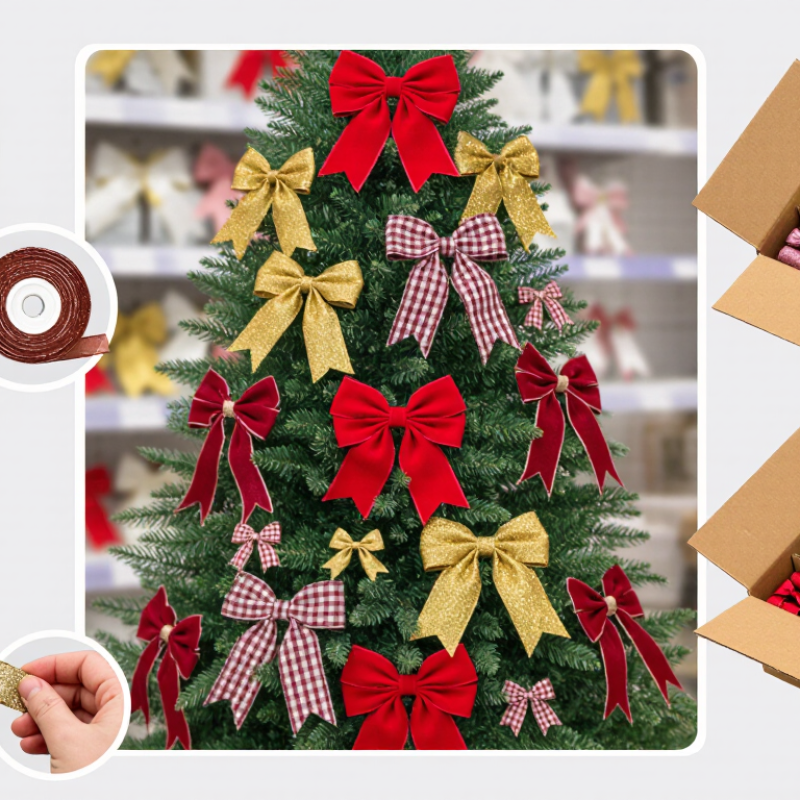
How to Choose Christmas Tree Bows for Bulk Orders

Define Christmas Tree Bow Types and Bulk Order Requirements

Christmas tree bows fall into three practical categories: tree toppers, branch accents, and ribbon bows with trailing tails.

Toppers need enough structure to hold their shape above the highest branches. Branch accents should sit securely without pulling smaller stems downward.

Wired ribbon allows reshaping, while unwired ribbon usually creates softer loops. Shape matters. For bulk purchasing, define each style by finished width, tail length, ribbon material, and attachment method.

Turn those definitions into measurable order requirements. An example specification might request 8-inch-wide red velvet bows, 12-inch tails, wired edges, and attached fastening ties. Specify whether measurements apply before packing or after reshaping, since compressed loops can make delivered bows appear smaller than expected.

Request a finished sample. Check it against the actual tree foliage, especially when dark green branches could hide narrow ribbon tails. A beautiful sample can still be impractical if attaching each bow takes several minutes.

Calculate quantities from a trial arrangement rather than relying entirely on tree height. Record the bows used per tree, multiply by the number of trees, and add a clearly stated replacement allowance.

Confirm minimum order quantities, units per carton, production timing, and whether delivery dates include transit. Ask suppliers to identify acceptable variation in dimensions and color between batches.

Packing deserves attention too: tightly stacked velvet bows may arrive creased, creating extra preparation work that a low unit price can easily obscure.


Compare Bow Materials, Finishes, and Durability

For bulk Christmas tree bows, compare finished samples under the lighting your customers will actually use. Polyester satin gives crisp color and a smooth surface, but glossy finishes can reveal creases. Velvet creates deeper shadows and fuller-looking loops, although compressed piles may need brushing after shipping. Jute offers a rustic texture, with some shedding and natural shade variation. Touch matters. A beautiful sample can still feel disappointingly thin.

Match the finish to the display conditions. Matte surfaces soften reflections, while metallic coatings catch light and make scratches more noticeable. Glitter deserves scrutiny. Shake samples over white paper to compare particle loss before approving production.

Wired edges help reshape flattened loops, but exposed wire ends can snag branches or fingers. Request finished-bow dimensions, fabric weight, wire specifications, and care instructions. For outdoor orders, request documented colorfastness testing, such as AATCC TM16.3, rather than accepting “fade-resistant” without evidence.

Durability also affects replacement costs and waste. The U.S. Environmental Protection Agency’s Advancing Sustainable Materials Management: 2018 Fact Sheet reports 17 million tons of textile waste generated. Only 14.7% was recycled; these figures cover textiles broadly, rather than bows specifically. That context supports checking whether decorations survive storage and reuse. Flatten, unpack, and reshape samples several times, recording fraying, coating loss, and loose seams. I would initially favor heavier velvet, but shipping compression could change that choice. Slightly uneven loops may be acceptable; unraveling seams deserve a stricter rejection threshold.

Choose Bow Sizes, Colors, and Attachment Methods

The National Christmas Tree Association’s industry statistics estimate that Americans purchase 25–30 million real Christmas trees annually. That market scale makes clear specifications important for bulk bow orders. Specify finished bow width, ribbon width, tail length, and quantity per carton. For a seven-foot tree, trial six-inch bows across the branches and larger bows near the top. These are starting dimensions, not established industry standards. Test one tree. Oversized loops can hide ornaments, while long tails may catch on neighboring branches.

Choose colors against the actual foliage, lighting, and surrounding decorations. Burgundy can appear almost brown under warm lighting; pale gold may disappear against champagne ornaments. Request physical swatches from the intended production batch, because screen colors cannot reliably show texture or sheen. Check them after dark. For coordinated displays, specify one dominant color and one accent, then record their approved proportions. An all-matching palette can still feel flat; mixing matte and lightly reflective finishes deserves a sample trial.

Match attachment methods to branch thickness and installation needs. Flexible ties suit many artificial branches, while clips require enough grip to prevent rotating. For natural trees, test attachments on several branch diameters before committing to the full order. Conceal wire ends and avoid crushing needles. Reusable straps may simplify removal, but visible fastening material can spoil close-up displays. Ask for an assembled sample, then check slippage, exposed ends, and bow shape after repeated attachment.

Evaluate Supplier Samples, Quality Standards, and Bulk Pricing

Supplier samples should reflect the Christmas tree bows you intend to purchase, including ribbon width, color, and fastening method. Request three to five samples from the proposed production materials. Check the details. Bend wired edges repeatedly, then inspect for exposed wire, fraying, and uneven stitching. Compare colors under daylight and warm indoor lighting. A deep red bow can appear brown beside warm tree lights, which product photographs may hide.

Define acceptable quality before placing a bulk order. For example, specify a 10-inch finished width with a half-inch tolerance, provided that variation suits your display. Ask suppliers to confirm ribbon composition, attachment strength, and packing methods in writing. Test the attachment. Fasten a sample to a branch and gently tug it to check whether it slips. A slightly uneven loop may be acceptable for a rustic display, although inconsistent sizing can still make installations look careless. Samples cannot guarantee every carton will match; agree on inspection criteria and remedies for defective pieces.

Compare quotations using the same specifications and delivery terms. Request prices at 500, 1,000, and 2,500 pieces, including setup charges, packaging, freight, and applicable import costs. Check whether bows arrive shaped or flattened. Flattened packaging may reduce freight costs, but reshaping hundreds of bows adds labor. The lowest unit price can be tempting; overlooking preparation time is an easy purchasing mistake. Ask how long the quotation remains valid and whether repeat orders require a new color approval.

Choosing Christmas Tree Bows for Bulk Orders: Inspection Sample Sizes

When evaluating supplier samples and bulk quotations, distinguish approval samples from shipment inspection samples. The chart shows standard inspection sample sizes for four order-size ranges, using General Inspection Level II, normal single sampling, and an AQL of 2.5 under ANSI/ASQ Z1.4.

Inspection sample sizes: 501–1,200 bows: 80; 1,201–3,200 bows: 125; 3,201–10,000 bows: 200; 10,001–35,000 bows: 315.

For example, a shipment of 5,000 bows falls in the 3,201–10,000 range and uses a 200-piece inspection sample under these settings. Select samples randomly across the shipment and assess agreed requirements such as dimensions, color consistency, ribbon condition, bow shape, and attachment security.

Before ordering, approve a reference sample and agree on defect classifications and acceptance criteria. AQL 2.5 is a sampling-plan parameter, not a guarantee that a shipment contains no more than 2.5% defective bows. Compare bulk quotations on the same specifications, including packaging, freight, inspection costs, and replacement terms.

Data source: ANSI/ASQ Z1.4, Table I and Table II-A; General Inspection Level II, normal single sampling, AQL 2.5. Values are standard sampling-plan quantities, not supplier performance data or market prices. Use the full standard to determine acceptance and rejection numbers and applicable switching rules.

Confirm Order Quantities, Packaging, and Delivery Schedules

Bulk Christmas tree bow orders need clear quantities, protective packaging, and delivery dates tied to your decorating schedule. Count the trees, then list bows needed for each tree size and display area. For example, 40 trees using six bows each require 240 bows before adding replacements. A 5% spare allowance adds 12 bows, though delicate fabrics or frequent handling may justify more. Check carton quantities. If cartons contain 50 bows, ordering 300 instead of 252 creates extra stock that needs storage.

Tips: Ask for a packed sample, especially when ordering wired ribbon bows with shaped loops. Confirm whether bows arrive flat, pre-shaped, individually bagged, or separated by cardboard dividers. Flat packing saves space but adds shaping time, which buyers sometimes underestimate. Request carton dimensions, gross weight, and labels showing color, size, and quantity. For mixed orders, separate colors by inner bag to make counting and distribution easier.

Work backward from the installation date, allowing time for receiving, inspection, and reshaping. Put production completion, dispatch, and expected arrival dates in the purchase order. Dates need definitions. A dispatch date means the goods leave the supplier; it does not mean they reach your warehouse. Ask how delays and damaged cartons will be handled, and agree on a reporting window. A one-week buffer may look comfortable, but it could prove inadequate during peak seasonal shipping.

How to Choose Christmas Tree Bows for Bulk Orders - Confirm Order Quantities, Packaging, and Delivery Schedules

Use this purchasing checklist to document bow specifications, calculate packing quantities, and agree on delivery milestones before placing a bulk order.

Calculations below use clearly stated planning examples. They are mathematically verifiable examples, not reported supplier specifications, minimum order quantities, or delivery commitments.
Order Checkpoint Details to Confirm Calculation or Reference Required Order Record
Bow Specifications and Order Quantities
Bow Size and Construction Finished width, overall height, tail length, ribbon width, material, wired or unwired edges, and attachment method. Record dimensions in one consistent unit. 1 inch = 2.54 cm exactly. State whether the finished height includes the tails. A dimensioned specification and an approved sample or sample photographs with measurements.
Color and Design Allocation Quantity for each color, size, and design combination. Example: 400 red bows + 400 gold bows + 400 silver bows = 1,200 bows. An itemized order showing the quantity and approved color reference for every variant.
Minimum Order Quantity Whether the minimum applies to the whole order, each design, each color, or each packaging format. There is no single minimum order quantity that applies to all Christmas tree bows. Obtain the applicable minimum for each ordered variant. Written minimum quantities and any required ordering increments.
Optional Reserve Quantity The additional quantity required for replacements or extra installations. Example: 1,200 bows × 5% = 60 reserve bows; total requirement = 1,260 bows. The 5% is an example planning choice. A stated reserve allowance and a final quantity adjusted to the agreed packing increments.
Packaging and Shipment Calculations
Inner-Pack Quantity Number of bows per bag, sleeve, tray, or inner box; whether colors are packed separately. Example: 1,200 bows ÷ 25 bows per inner pack = 48 inner packs. An agreed inner-pack count and a packing method that protects the approved bow shape.
Master-Carton Quantity Inner packs per carton, bows per carton, and whether partial cartons are permitted. Example: 4 inner packs × 25 bows = 100 bows per carton; 1,200 bows ÷ 100 = 12 full cartons. A packing list stating carton count and the contents of each carton.
Rounding to Full Cartons Whether the order must be increased to a full-carton quantity. Example: a 1,260-bow requirement at 100 bows per full carton requires 13 cartons and 1,300 bows if only full cartons are allowed. The final billable quantity, including any increase caused by packing increments.
Carton Dimensions and Volume External carton length, width, and height after packing. Volume in m³ = length × width × height in cm ÷ 1,000,000. Example: 60 × 40 × 40 cm = 0.096 m³; 12 identical cartons = 1.152 m³. Measured external dimensions for each carton type and the total shipment volume.
Shipment Weight Net product weight and gross packed weight, including cartons and packing materials. Total gross weight = sum of all packed-carton weights. Example: 12 cartons at 8 kg each = 96 kg gross weight. Actual packed weights. Chargeable freight weight must be confirmed using the selected carrier’s rules.
Shape Protection and Labels Whether bows arrive preformed or flat, how loops and tails are protected, and what assembly is required. Check a packed sample for crushing, creasing, tangling, and label accuracy. Record item code, color, quantity, and carton number. Approved packaging photographs, assembly instructions where needed, and carton-label artwork.
Production and Delivery Schedule
Production Start The event that starts the production lead time, such as sample approval, artwork approval, or receipt of the agreed deposit. Record the start date and specify whether the quoted lead time uses calendar days or working days. A confirmed production start date, completion date, and list of prerequisites.
Pre-Shipment Inspection Inspection timing, sample approval criteria, quantity checks, packaging checks, and correction time. Schedule inspection before shipment release and allow time for agreed corrective work. An inspection date, acceptance criteria, and a named party responsible for release approval.
Dispatch and Arrival Cargo-ready date, carrier handover date, shipping service, destination, and required arrival date. Dispatch is the shipment’s departure or handover milestone; arrival is a separate milestone. Confirm both dates explicitly. A dated shipping schedule identifying estimated dates and any carrier-backed delivery commitments.
Latest Order Date Approval time, production time, inspection time, transport time, applicable customs clearance, and receiving buffer. Plan backward from the required arrival date using the agreed activity sequence. Include non-working days and identify activities that can overlap. A backward schedule based on confirmed durations, with responsibility assigned to each milestone.
Delivery Terms and Receiving Delivery location, freight and clearance responsibilities, receiving hours, unloading requirements, and carton-count checks. If using Incoterms®, state the selected rule, named place or port, and edition. Record the required delivery date separately. Agreed delivery terms, destination contact details, and a receiving checklist.

Before confirming the order: Replace the example quantities, dimensions, and weights with approved order data. Obtain written confirmation of product specifications, packing details, production dates, and delivery arrangements.