
Leave Your Message

China Top Personalized Christmas Stockings Manufacturer?

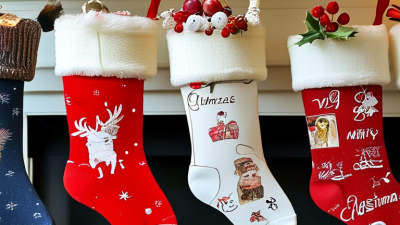
Personalized Christmas Stockings have moved beyond simple holiday décor. They now combine family identity, gifting emotion, and small-batch manufacturing. Names, initials, dates, and woven patterns turn a familiar fireplace item into a personal keepsake. Yet personalization adds pressure. Every letter must be correct, centered, and durable.

Deloitte’s 2024 Holiday Retail Survey found that consumers planned to spend an average of $1,778 during the holiday season. The National Retail Federation also forecast record U.S. holiday sales between $979.5 billion and $989 billion in 2024. These figures indicate strong seasonal demand, but they do not guarantee success for every stocking manufacturer. Buyers still compare fabric quality, embroidery precision, delivery speed, and return support. Small details matter.

B. Joseph Pine II, co-author of Mass Customization, wrote, “Mass customization is the new frontier in business competition.” His observation fits Personalized Christmas Stockings closely. Customers want something unique without accepting unreasonable prices or long waiting times. A reliable manufacturer must balance flexible design with repeatable production. Cotton texture, thread tension, lining strength, and color consistency deserve careful inspection. A cheerful design cannot excuse weak stitching. That is the uncomfortable part.

This guide examines how a top manufacturer should approach materials, customization systems, sampling, quality control, and international fulfillment. Reported spending data offers useful direction, but it has limits. Consumer behavior changes quickly, and seasonal forecasts can miss sudden shifts. The strongest supplier therefore combines industry evidence with practical production experience. It listens carefully, tests physical samples, and improves after each holiday season.

China Top Personalized Christmas Stockings Manufacturer?

China’s Christmas Stocking Supply Base: 2023 Textile Exports at US$293.6B

China Top Personalized Christmas Stockings Manufacturer?

China’s textile supply base reached US$293.6 billion in exports in 2023, according to industry trade data compiled from China Customs. The WTO’s World Trade Statistical Review 2024 also confirms China’s continuing strength in global textile manufacturing. This scale supports flexible sourcing for personalized Christmas stockings, including knitted, fleece, velvet, and recycled-fiber options.

A capable manufacturer should manage more than fabric selection. Buyers should check sample accuracy, embroidery density, colorfastness, stitching strength, and packing consistency. Small details matter. A stocking may look attractive online but fail after repeated handling. Export suppliers can usually support custom names, seasonal patterns, hanging loops, lining, and carton-level packing requirements. The International Trade Centre’s Trade Map data helps buyers compare textile trade flows and identify realistic sourcing markets.

However, export volume alone does not prove factory quality. That assumption needs testing. Request recent samples, production photographs, material specifications, and inspection records. Ask how the factory controls thread trimming and personalized spelling. A single wrong letter can damage an entire order. Lead times also change during peak production months. In my experience, clear artwork files and approved pre-production samples prevent more problems than aggressive price negotiations. Suppliers should also explain whether the quoted price includes packaging, sampling, and export documentation. Each point deserves written confirmation.

How to Verify Manufacturers Through ISO 9001, OEKO-TEX, and Audit Data

China Top Personalized Christmas Stockings Manufacturer?

Verifying a personalized Christmas stocking manufacturer requires more than attractive samples. Check the ISO 9001 certificate number, legal entity, factory address, and certification scope. ISO Survey 2022 recorded 1,265,216 valid ISO 9001 certificates across 189 economies. Certification signals a documented quality system, not perfect production. Ask for the latest audit report and evidence of corrective actions. I have found that expired certificates are surprisingly common during supplier screening.

OEKO-TEX verification should cover the actual fabric, thread, dyes, and printed decorations. Confirm the certificate number through the official database, then compare its product scope with your stocking design. OEKO-TEX reported more than 35,000 certificates and labels worldwide in 2023. This figure shows broad adoption, but it does not replace product testing. Request recent test reports, production samples, and batch records. Small details matter, such as color bleeding after washing and loose decorative fibers.

Tips: Match every certificate to the exporting factory, not only the trading office. Review audit dates, worker-safety findings, environmental observations, and closure evidence. A one-page audit summary is not enough. Ask for dated photos, production records, and random inspection results. Sedex’s Responsible Business Report 2023 emphasizes that corrective action tracking is central to responsible supply-chain monitoring. Still, audit data can miss seasonal subcontracting. That is where my own verification process remains imperfect: repeat inspections and unannounced checks offer stronger confidence.

China Top Personalized Christmas Stockings Manufacturer? How to Verify Manufacturers Through ISO 9001, OEKO-TEX, and Audit Data

The chart shows the number of core evidence fields to check when validating a manufacturer. These checks cover certificate identity, scope, site information, validity, audit findings, and corrective-action closure.

ISO 9001 focuses on the quality management system, OEKO-TEX® STANDARD 100 focuses on harmful-substance testing for textile products, and audit data helps verify actual site performance and follow-up actions. Checklist counts are verification criteria, not market-share or company-performance statistics.

Personalization Methods Compared by MOQ, Cost, and Production Capacity

China Top Personalized Christmas Stockings Manufacturer?

Personalization Methods Compared by MOQ, Cost, and Production Capacity

Choosing a Chinese manufacturer starts with the decoration method, not the lowest quotation. McKinsey’s personalization research found that 71% of consumers expect personalized interactions. However, 76% feel frustrated when personalization fails. A crooked name can damage trust quickly.

Embroidery suits premium stockings with thick cuffs and classic textures. Typical MOQ starts around 100 pieces, with decoration costs near $0.35–$1.20 per name. Skilled lines may produce 500–1,500 pieces daily. Production slows when every name uses different colors. It happens.

Heat-transfer printing supports smaller orders, often from 30–50 pieces. It costs about $0.20–$0.70 per name and handles detailed artwork well. Daily output can exceed 2,000 pieces with prepared files. Yet, poor pressing may cause peeling after washing. Request a wash-test report.

Sublimation works best on light-colored polyester surfaces. It can begin near 20–50 pieces, with low setup costs and strong image detail. Capacity may reach 2,000–5,000 pieces daily. Woven labels usually require 300–500 pieces because of loom setup. They remain durable but add sewing labor. According to the National Retail Federation’s 2024 holiday survey, planned seasonal spending averaged $1,007 per consumer, showing room for premium gift presentation. Still, budget decisions need production evidence. Ask for a pre-production sample, daily capacity records, defect rates, and carton dimensions. A supplier promising everything deserves careful questioning.

Quality Benchmarks: AQL 2.5, GSM, Stitch Density, and Colorfastness

China Top Personalized Christmas Stockings Manufacturer?

Quality Benchmarks: AQL 2.5, GSM, Stitch Density, and Colorfastness

A dependable personalized Christmas stocking manufacturer should measure more than appearance. During factory inspections, I check finished samples under bright, even lighting. An AQL 2.5 inspection allows limited defects in a controlled shipment. It does not mean every piece is flawless. Critical issues, such as broken hooks or open seams, still require immediate rejection. Sampling records should show quantities, defect types, and corrective actions.

GSM helps confirm fabric weight and hand feel. A 280 GSM fleece stocking feels fuller than a thin 180 GSM version. However, higher GSM alone does not guarantee durability. Stitch density matters too. Tight, even stitches protect embroidered names and reduce seam separation. I normally inspect the toe, cuff, hanging loop, and personalization area closely. Small gaps often appear there first. Not perfect.

Colorfastness needs practical testing. A damp white cloth can reveal loose dye after rubbing. Washing tests should also check red trims against pale fabric. Heat exposure may change printed letters or metallic threads. Production teams should compare results with approved samples, not memory. I prefer dated inspection photos and signed test reports. These details make quality claims easier to verify and help buyers improve the next production run.

China Top Personalized Christmas Stockings Manufacturer? - Quality Benchmarks: AQL 2.5, GSM, Stitch Density, and Colorfastness

Quality Dimension Recommended Benchmark Verification Method Quality Notes
AQL Inspection Major defects: AQL 2.5
Minor defects: AQL 4.0
Critical defects: 0
ISO 2859-1, General Inspection Level II, normal single sampling AQL is a sampling acceptance limit, not a guarantee that the total shipment contains the same defect percentage. The sample size and acceptance number depend on the lot size.
Fabric Weight (GSM) Polyester felt: 220–350 g/m²
Velvet or plush: 180–300 g/m²
Lining fabric: 80–150 g/m²
Conditioned fabric sample tested with a calibrated GSM cutter and precision balance A production tolerance of approximately ±5% is commonly used unless the approved specification requires a tighter range.
Stitch Density Structural seams: 10–14 stitches per inch (SPI)
Decorative embroidery: 4–8 mm stitch length, design-dependent
Visual inspection and measurement with a stitch gauge or calibrated ruler The stitch setting should prevent seam opening without causing puckering, fabric distortion, skipped stitches, or excessive thread tension.
Seam Strength No visible seam opening under a 5 kg static load for 60 seconds on the approved construction sample Load test on the hanging loop, upper seam, and decoration attachment points The exact requirement should be confirmed against the product design, fabric type, and intended load.
Colorfastness to Washing Grade 4 or better for color change and staining ISO 105-C06 or an equivalent buyer-approved laundering method Test conditions should match the care instructions, fiber composition, and decoration materials used in the final product.
Colorfastness to Rubbing Dry rubbing: Grade 4 or better
Wet rubbing: Grade 3 or better
ISO 105-X12 using dry and wet rubbing cloths Dark red, green, navy, and heavily printed areas should receive additional attention because transfer risk can be higher.
Colorfastness to Light Blue Wool reference Grade 4 or better for standard indoor decorative use ISO 105-B02 or an equivalent controlled light-exposure test Light exposure performance varies by dye, pigment, fiber, and finishing process; an approved shade standard should be retained.
Dimensional Stability Maximum change: ±3% after the specified care test Measure marked points before and after washing or conditioning The test method must follow the final care label. Non-washable decorative products should be tested for handling and moisture exposure instead.
Personalization Accuracy 100% correct name, spelling, font, position, and thread or print color One-by-one comparison with the approved personalization file and pre-production sample Personalized text should be checked separately from general workmanship because an otherwise acceptable item may still be unusable if the personalization is incorrect.
Packaging and Safety Clean folding, secure attachments, no loose needles or sharp components, and packaging suitable for the destination market Final random inspection, metal detection where required, and review of applicable destination-market requirements Children’s-use claims, hanging-loop design, labeling, and chemical requirements should be assessed according to the intended market and product classification.

Note: These benchmarks are general reference values for personalized textile Christmas stockings. The final acceptance criteria should be confirmed in the approved product specification, sealed sample, care instructions, and destination-market requirements.

How to Rank Suppliers by Lead Time, Compliance, Capacity, and Total Cost

China Top Personalized Christmas Stockings Manufacturer?

How to Rank Suppliers by Lead Time, Compliance, Capacity, and Total Cost

A dependable supplier ranking starts with verified lead time, not a sales promise. Measure days from approved sample and deposit to packed goods. Request a production schedule with fabric booking, embroidery, inspection, and shipping dates. A small sample order can reveal more than a polished presentation. Delays often begin with unclear artwork files or late material approval.

Compliance must be checked before comparing prices. Ask for material composition records, factory certifications, product test reports, and traceable subcontractor details. Requirements vary by destination market, so confirm them with an independent testing body or qualified customs adviser. Do not accept copied documents. Check names, dates, product scope, and issuing organizations. Small details matter.

Capacity should reflect peak-season reality. Request monthly output, current order loading, machine numbers, skilled worker availability, and backup production plans. Then calculate total cost, including sampling, custom labels, packaging, inspection, rework, freight, duties, and payment fees. The cheapest quotation may become expensive after one missed sailing. No scorecard is perfect. I would give more weight to recent evidence than confident promises. A supplier with slightly higher pricing may offer better control, clearer communication, and fewer surprises. Rank each supplier with documented scores, but leave room for human judgment. Production is never entirely predictable.