
Holiday shoppers often make their first judgment before entering a store. The doorway becomes a silent sales associate. Christmas Door Decorations can signal warmth, quality, and seasonal relevance within seconds. However, attractive decoration alone does not guarantee stronger sales.
The National Retail Federation forecast 2024 U.S. holiday sales between $979.5 billion and $989 billion. That estimate reflects a competitive retail season, where stores must earn attention quickly. Deloitte’s 2024 holiday retail survey reported expected average consumer spending of $1,778. This figure highlights both opportunity and pressure for retailers. Every visual choice should support a clear commercial purpose.
A useful selection process begins with the customer and the storefront. Consider the entrance width, pedestrian traffic, lighting, weather exposure, and brand colors. A small boutique may suit a narrow wreath with warm white lights. A department store may need layered garlands, oversized bows, and visible price messaging. Keep pathways clear. Protect sightlines and door hardware.
Safety matters.
Materials should resist moisture, wind, and frequent handling. Fire-resistant products and secure installation methods should follow applicable local requirements. Retail teams should also inspect decorations daily, especially after rain or heavy customer traffic. This practical step is easy to miss.
Retailers can compare three options: premium reusable pieces, low-cost seasonal items, and modular designs. Modular displays often provide better long-term value, although their appearance may feel less distinctive. That trade-off deserves honest review. Track entrance traffic, dwell time, customer comments, and sales changes before repeating the design. A beautiful doorway may attract photographs, but the real test is whether it improves the shopping journey.
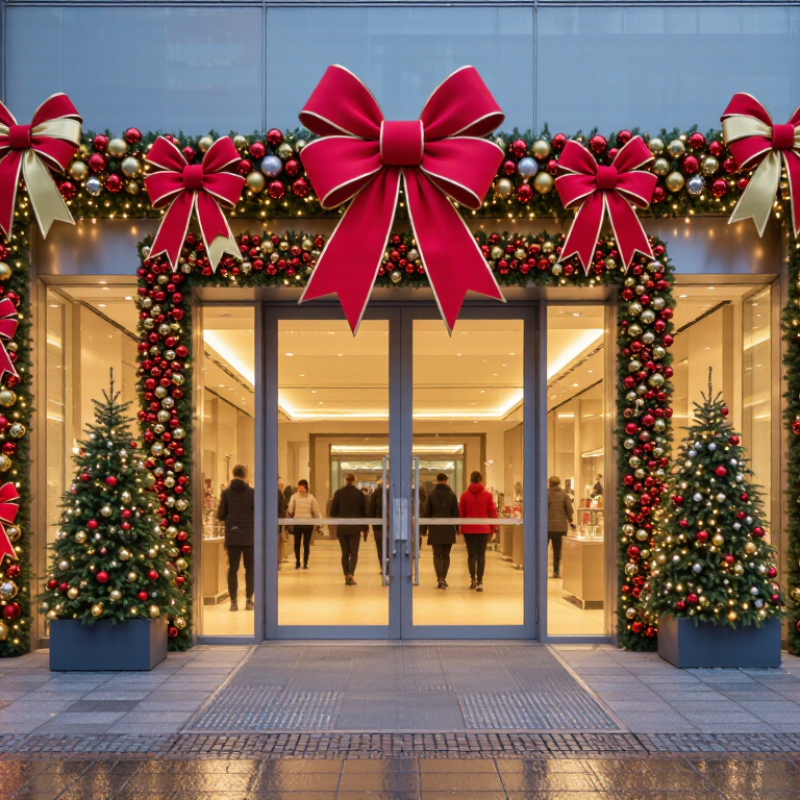
How to Choose Christmas Door Decorations for Retail
Retail door decorations should support a commercial purpose: attract attention, guide movement, and frame seasonal offers. The National Retail Federation forecast 2023 holiday sales between $957.3 billion and $966.6 billion, with a midpoint of $964.4 billion. That expected 3% to 4% growth created strong pressure on retailers to make every entrance work harder.
The same forecast estimated online and non-store sales at $273.7 billion to $278.8 billion. Physical stores still mattered. A doorway can connect digital browsing with in-store discovery through clear product themes and visible price messages. Use decorations that match the store’s customer profile, not only popular holiday colors. Red and gold may look familiar, but they can also feel generic. That is an uncomfortable detail worth testing.
Tips: Keep displays below sightline height. Leave the first two meters clear for carts and foot traffic. Use one strong focal point, such as a textured wreath or warm-lit arch. Check the entrance from outside, inside, and from the nearest aisle. A design that looks impressive in a photograph may block merchandise or create visual clutter. The U.S. Census Bureau’s retail data also shows the importance of connecting store visits with online shopping behavior. Add a simple QR sign only when it serves a clear purpose.
Data-led selection framework for seasonal door decoration assortments
| Retail Dimension | Verified 2023 Data | What It Means for Door Decorations | Selection Direction |
|---|---|---|---|
| Total holiday retail sales | $964.4 billion | The holiday period represents a large, concentrated seasonal retail opportunity. | Build a broad assortment with entry, mid-range, and premium options. |
| Year-over-year holiday sales growth | 3.8% increase from 2022 | Demand expanded, but customers remained value-conscious. | Prioritize reusable, durable, and visibly high-value designs. |
| Holiday sales comparison | 2022: $929.5 billion 2023: $964.4 billion |
The market added approximately $34.9 billion in holiday sales year over year. | Use seasonal displays to encourage add-on purchases at store entrances. |
| Online and non-store holiday sales | $276.8 billion | Online and non-store channels accounted for approximately 28.7% of total holiday sales. | Provide clear product dimensions, installation details, and multiple product images. |
| Online and non-store sales growth | 7.5% increase from the prior holiday season | Digital holiday shopping grew faster than total holiday sales. | Offer lightweight, easy-to-ship decorations and packaging that protects fragile components. |
| Average planned holiday spending per consumer | $1,028 | Consumers planned to allocate meaningful budgets across gifts and seasonal non-gift purchases. | Create good-better-best price architecture rather than relying on one price point. |
| Planned spending on gifts | $658 per consumer | Most planned holiday spending was directed toward gifts. | Use giftable door décor, compact packaging, and ready-to-display presentation. |
| Planned spending on non-gift holiday items | $239 per consumer | Non-gift seasonal purchases had a defined place in household holiday budgets. | Include practical décor for homes, offices, apartments, and temporary displays. |
| Planned spending on other holiday items | $130 per consumer | Additional seasonal spending supports impulse-friendly and complementary products. | Merchandise hooks, ribbons, hanging accessories, and small coordinating pieces nearby. |
| Official holiday measurement window | November 1 through December 31 | The key selling period spans two full calendar months. | Launch core décor before November and maintain replenishment through late December. |
Data note: Holiday sales figures refer to U.S. retail sales for November 1–December 31 and exclude automobile dealers, gasoline stations, and restaurants. The approximate online share is calculated as $276.8 billion divided by $964.4 billion.
Source: National Retail Federation 2023 holiday sales reporting and 2023 holiday consumer spending survey.

Choosing Christmas door decorations for retail begins with the doorway, not the display theme. Measure the clear passage with the door fully open, including handles, hinges, and nearby fixtures. Keep at least 36 inches of unobstructed route where your accessibility plan requires it. Decorations must never reduce this space.
In my retail planning experience, oversized wreaths and hanging ribbons create the most common problems. A wreath may look centered but swing into the walking path. Secure it firmly, then test the door during busy traffic periods. Check floor mats, electrical cords, baskets, and promotional stands too. Small changes can create real barriers. I once approved a display that passed a tape-measure check but blocked a stroller when the door opened. That mistake changed our inspection routine.
Tips: Mark the 36-inch path with removable floor tape before installing decorations. Photograph the doorway from both sides. Ask an employee using mobility equipment to test the route, if available. Recheck after delivery boxes arrive. Keep emergency access clear, and confirm local accessibility requirements with a qualified professional. Measurements can shift when seasonal fixtures move. Be willing to revise the design. A beautiful entrance should welcome customers without asking them to navigate around it.
Choosing Christmas Door Decorations for Retail
Retail doors face more abuse than living-room entrances. Rain, sunlight, dust, repeated handling, and temperature changes can quickly damage decorative materials. Choose UV-resistant plastic, treated fabric, or corrosion-resistant metal for exposed areas. Sealed edges help prevent moisture from reaching internal components.
UL 588 is a useful reference for seasonal and decorative products. It addresses construction, electrical safety, and performance requirements for covered products. However, a UL 588 reference does not automatically mean every decoration is suitable for outdoor use. Check the product marking, installation instructions, and certification details before placing it near an entrance. The intended location matters.
Look closely at connectors, wire insulation, clips, and mounting points. They should remain secure when wind moves the decoration. Keep electrical connections away from puddles and wet floor areas. A ground-fault protective device may provide additional protection where local requirements call for it. Never hide damaged cords beneath mats or door frames.
Test one sample for several days. Watch for fading, loose stitching, condensation, or brittle plastic. I once underestimated strong afternoon sunlight; the color changed faster than expected. That mistake was avoidable. Also measure the door swing, because a beautiful wreath can obstruct customers or create pressure on cables. Weather resistance is only one part of a safe, durable retail display.
Retail Christmas door decorations should create warmth without narrowing safe movement. NFPA data reports an average of about 160 home Christmas tree fires each year. That figure is not a retail-door statistic, but it highlights a real seasonal risk: dry greenery, paper ornaments, lights, and heat can combine quickly.
Choose decorations made from materials marked flame resistant, and keep them away from heaters, candles, cooking equipment, and electrical panels. Leave doors, exit routes, sprinklers, alarms, and emergency signs fully visible. A large wreath may look attractive, yet its wire frame can catch clothing or block a narrow doorway. Measure the opening before purchasing. Check that fasteners cannot fall onto customers or staff.
Inspect displays at opening and closing. Look for frayed cords, warm plugs, loose branches, and decorations touching light fixtures. Remove damaged items immediately. Use only suitable, tested electrical equipment, and avoid overloading outlets or extension connections. Keep real greenery fresh, because dry needles ignite more easily. Store replacement decorations in a cool, dry area.
A practical checklist helps, but it is not perfect. Staff may miss a loose cable during a busy evening. Add a second inspection after peak shopping hours, and record what was checked. Ask a qualified safety professional to review unusual layouts, especially near exits or crowded entrances. Local fire requirements can differ, so confirm them before installation. Beautiful displays deserve careful judgment, not just careful styling.
How to Choose Christmas Door Decorations for Retail
Christmas door decorations should earn their space, not merely attract compliments. Measure the decoration’s return on investment through traffic, conversion, and sales lift. Before installation, record average daily entrances, conversion rate, and sales for comparable weekdays. Photograph the doorway from the parking area and sidewalk. Visibility matters.
The National Retail Federation reported that 2024 holiday retail sales were expected to reach $979.5–$989 billion. That scale makes small improvements worth testing. Use a simple control comparison: decorate selected entrances, then compare them with similar undecorated entrances. Track door-zone traffic with people counters, not guesses. A 12% traffic increase means little if conversion falls by 3%. Measure both.
Keep the design bright, uncluttered, and easy to enter. A seven-second observation can reveal whether garlands block the handle or signage. Test two versions across similar time periods. Record sales lift, average transaction value, and returns. The U.S. Department of Energy notes that lighting can significantly affect seasonal electricity use, so include energy costs in ROI calculations. Small stores may need a manual tally. That is imperfect, but useful. Weather, promotions, and weekend crowds can distort results. Document them carefully.
A practical formula is: incremental gross profit minus decoration, labor, energy, and storage costs, divided by total campaign cost. A positive result is encouraging, not conclusive. Repeat the test next season.
Measure Decoration ROI Through Traffic, Conversion, and Sales Lift
The chart compares decoration levels using three measurable outcomes: incremental store traffic, conversion-rate improvement, and sales lift. Select the decoration level that produces a meaningful sales increase without allowing decoration costs to outweigh the incremental revenue.